Press "Enter" to skip to content

SPARC

Proposed By-Law Change to be Considered at April 7, 2017 Meeting

UPDATE
At the April 7, 2017 meeting, this motion was presented, seconded, discussed but voted down therefore the by-laws remain unchanged.

Pursuant to the notification rules, at the April 7th, 2017 meeting, SPARC will consider a By-Law change. This was introduced at the last meeting.

The proposed change is as follows:

Proposed to amend Article 5, Section 1 by adding

2. Prior to a vote of the membership authorizing a non emergency equipment expenditure >$200 the Secretary or party designated by the Secretary, shall make notice as to the type of equipment being sought by the club to the SPARC electronic mailing list 30 days prior to a final vote.  The intent of this notice shall be to locate needed equipment or substantially similar equipment locally, at reduced cost/donated from the SPARC membership.

The executive board shall have the power to designate expenditures exceeding this amount as emergency on a case by case basis.  An emergency expenditure is not subject to this section, however mailing list notice is still encouraged if possible.

Nothing in this section shall preclude debate during any meeting regarding proposed equipment expenditures.

Related Images:

Automatic Antenna Switch Decoder added to W4GAC Station

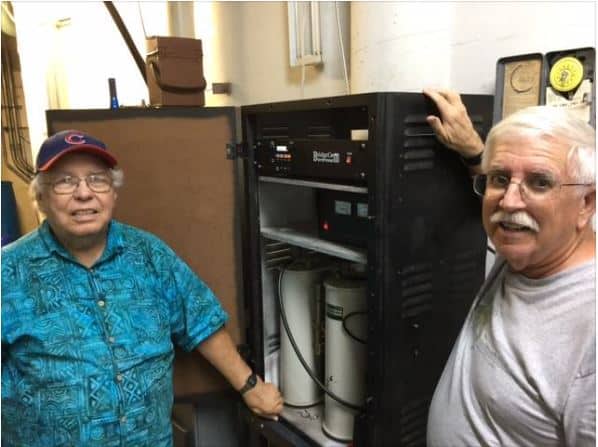
Ron KP2N and Tom NY4I added a Top Ten Devices Band Decoder to the W4GAC station. This switch ties into the existing Six Pack antenna switch. The idea is that rather than the operator having to select the right antenna, the Band Decoder follows a signal sent from the radio that tells the decoder what band the radio is on at the time. The corresponding position is then switched on the antenna switch. So when the radio is on bands 10m – 20m, the Log Periodic is selected. When it is on 80 or 40m, the dipole is selected. It is also possible to use alternate antennas (in case we want to have a 40m vertical as well).

This addition is also needed for the remote station as the manual selection switch would not work with a remote station to change antennas. Below are a couple of pictures of the project. One is the band decoder and another is a handy little DB-25 breakout Ron used to get the pin outs correct before he soldered up the DB25.

DB25 Breakout Board

Related Images:

Operators needed for W4S at the Sun n’ Fun International Fly-In & Expo in Lakeland.

Coverage is needed Tuesday, April 4, through Sunday, April 9, 2017. Operating hours are 0900 – 1700 each day except Sunday, 0900-1500. W4S will be setup at the back West exit of the Museum. General information on the Fly-In, can be found at the Sun n’ Fun web site click HERE.

Volunteer time will be 3 1/2 to 4 hours per day. I need to know the day they wish to and if they would like to work AM or PM hours. Volunteers will get a pass into the Fly-In for each day they operate, a parking pass as well as sandwiches for lunch and drinks.

If you would like to volunteer, please advise me of the day and AM or PM hours you would like to operate. I will do my best to honor your request, depending if someone has already requested that time period. Please contact me ASAP with Call sign, T-Shirt size and emergency contact. I will get all other information off QRZ.com. I prefer you contact me via email so I have information in Black & White. You are welcome to call or text me with any questions etc.

73,

Bob Flynn WA4OAB

1281 Forrest Hill Dr.

Clearwater, FL 33756

wa4oab@gmail.com

Phone: 727-458-4420

Related Images:

SPARC Members attend West Central Florida Section TECHCON

Section Manager Darrell KT4WX discussing PICAXE Microcontrollers.

On Saturday, February 25, several members of SPARC made the trip to Sarasota for the 3rd annual WCF section TECHCON. This is a free technical conference put on by the WCF ARRL section technical staff. The location changes to various places around the section to allow the most section members to attend.

This year, there were two conference tracks. One focused on more introductory topics such as station design, antenna building, APRS and programable microcontrollers such as the PICAXE and the Arduino. Another track discussed more technical topics including the Amateur Radio Emergency Digital Network (AREDN) and HamWAN—both which allow creating high-speed data networks similar to WiFi but over greater distances and utilizing amateur radio frequencies (HamWAN was presented by SPARC member Bryan Fields W9CR.

NY4I, W4OQM by NZ1Q
Tom NY4I and Charlie W4OQM – Photo by Ed NZ1Q

One of the benefits of these meetings besides the technical content is the chance to discuss the technical aspects with other hams. During breaks, it is common to hear hams discussing how they are applying the things learned in unique ways that you would not learn just reading the material from a magazine article in QST. For example, the two networking topics might seem competitive but during the Q&A sessions, we discussed how to couple the mesh capabilities of AREDN for emergency data networks wth the long distance networking backbone capabilities of HamWAN can complement each other to serve the widest area.

If you missed it, make plans to attend next year’s TECHCON (around the same time in February tentatively planned for somewhere in Polk county.

Related Images:

NAQP RTTY Effort a Success

The W4TA SPARC contest team set another club record this weekend. Eight operators were able to make 950 QSOs and 147 multipliers in 12 hours on four different bands for a total of 139,650 claimed points. Our previous record was 94,416 claimed points in July of 2012. Quite an improvement.

Special thanks to Ron, KP2N in organizing, preparing for and keeping the effort on track. Additionally for keeping the equipment humming (and making noise), and for his patience in mentoring the less experienced members of the team,

Additional thanks to Tom, NY4I, for getting our logging software up to date, to Joy, XYL of W4CU, for the batch of crockpot meatballs, to Ron, KP2N for the Sloppy Joes, to Roger, K4SHI, for the loan of a 15 meter bandpass filter, and to Tom, W4CU and Rex, KB8ESY for repairing the dipole support pole and getting it back in the air.

Operators participating in this contest were: Rex ,KB8ESY; Paul, KA4IOX; John, KI4UIP; Dave, KR4U; Ron, KP2N; Bob, N2ESP; Dee, N4GD; Scotty, N4RI; Don, VE3XD; Tom, W4CU and Leslie, WA4EEZ. 

This contest will be run again in July. If you would like to participate, contact one of the happy team members above for information.

“RYRYRYRY” (It’s a RTTY thing….)


Related Images:

SPARC Contesters Set New Club Record!!!

Prior to this weekend, the highest score the SPARC Contesters managed in the CQ WPX RTTY contest was a commendable 4th place (U.S) in the Multi operator, Single transmitter category with a 2.3 million-point showing in 2009. That effort used the callsign AK4K with operators KP2N, N1XX, N2ESP, N4RI, VE3XD and W4CU. After this weekend, that club record is no more.


AK4K 2009 WPX RTTY Certificate

This weekend’s effort in the CQ WPX RTTY contest exceeded that score by a good margin. Operators for this weekend’s contest were Ron KP2N, Tom W4CU, Scotty N4RI, Dave KR4U, Don VE3XD, Richard, N4BUA, Bob N2ESP, Johnnie W4TSP, Paul KA4IOX, Rex KB8ESY and Tom NY4I. The team kept the station on the air for the full 48 hours of the contest. A feat even more impressive when you consider this was also the weekend of the Orlando hamfest and several of the operators also attended the hamfest on Saturday. By this time you might be wondering, what the heck is the CQ WPX RTTY Contest?

As with most contests, the objective is to contact as many other stations as possible. The mode this weekend was RTTY, which is digital mode that you may hear above the PSK portion of the HF bands. It is distinctive by its characteristic “diddle” sound. As with any digital mode, the main interface is a computer that generates the keying signals for the radio (FSK) and decoding software that processes the received audio into text readable by the operator and the computer logging software. There are many types of contests and each has its own specific objectives. Usually one is interested in points—the number of stations you contact—along with multipliers, which are the unique twist for each contest. For example, in DX contests different countries count as a multiplier. So if I have 10 contacts—each for one point—and work 5 different countries, the score is 50. The scoring for each contact varies—as in this contest contacts with our own continent (North America) are worth one point, but contacts with other countries are worth 3 points. But the basic idea of multiplying QSO points by the number of unique “multipliers” gives the score. That means we always want to add as many multipliers as possible.  Now in many contests, there are far more US stations than DX stations. But in the WPX contest, unique prefixes are the multiplier. That means that if we use a call that has a somewhat rare prefix, we are the multiplier and other stations want to work us. This weekend we used your author’s callsign, NY4I. As NY4 is only a 2×1 prefix (there was no NY4AA or NY4AAA issued), there are only 26 stations in the entire world that have the NY4 prefix. While there are some NY4 stations that are also contesters (NY4A), we did not hear any other stations in this weekend contest. What this means, is that the operators at the club station could act like the DX stations and camp out in one place and call CQ the entire weekend. This is known as “running a frequency”. This is a much more efficient way to make contacts rather than searching for other stations and working them (Search & Pounce). If you have any wondered how it would be to operate on the other side of the pileup where stations call you, a prefix contest is the place to be.

Tom NY4I working another multiplier
WriteLog in operation

We had plenty of food available to keep the team running. The famous contest chili was there as well as hot dogs, drinks, doughnuts and the usual assortment of goodies in the station. As fas as the equipment, we used the newly elevated Log Periodic for the 20 and 15 meter bands and a simple dipole for the 80 and 40 meter band. The equipment was an Elecraft K3 and an SPE 1.3k-FA solid-state amplifier running around 1200 watts. The software used was the club standard WriteLog which particularly excels at RTTY contests.

So, how did we do? The total points submitted for this contest were over 3 million! We had 1923 contacts with 675 unique prefixes for a total score of 3,121,200. Not too bad at all! 

This was a great team effort led by Ron KP2N as the organizer. Many thanks to all the operators that came out and supported the effort. We will not know r where we placed in the standings for a few months, but regardless, this was a great testament to what this club station can do especially after the hard work of the club’s tower project. The only thing missing from this weekend was you! We had new operators this weekend as well as old pros. The camaraderie of the operating team makes it a great way to spend some time “playing radio”. As I have said many times, you do not need experience. You just need a desire to learn something new, have fun with some fellow hams, and get on the radio. Our next planned contest is also a RTTY contest but this is a short one. It starts at 1:00 PM on Saturday, February 25. Right after that is a phone contest on March 4rd. This is the ARRL SSB International DX contest. This contest encourages DX stations to work US stations so while not as big a multiplier as NY4 in a prefix contest, it still gives plenty of opportunities to work DX. Watch the new Club Station Activities page for more information. We welcome all to come down and operate or just stop by the watch and learn. I promise you will have a great time no matter what you choose to do.

Related Images:

WP2Social Auto Publish Powered By : XYZScripts.com