At the November 2026 SPARC meeting, members elected a new board. The new term started when the November meeting adjourned, so this board is in office now.
The elected board positions are as follows:
Marty Sharp W4AFP – President
Pat Connelly AA0O – Vice President
Will Scott W7WMS – Treasurer
Bruce Solov K2BHS – Secretary
John Toth KI4UIP – Board Member 1
Nic Nichols KZ0J – Board Member 2
Glenn Kaufman KR4BOG – Board Member 3
Also serving: Tom NY4I (Immediate Past President), Dave KR4U (Station Trustee), Carol De La Torre AB4YU (W4TA Station Trustee), Paul KA4IOX (Contest Coordinator), Bob N2ESP (President Emeritus).
From left: Bob N2ESP, Dave KR4U, Tom NY4I (seated), Nic KZ0J, Glenn KR4BOG, Bruce K2BHS, Pat AA0O, Will W7WMS, Marty W4AFP, Paul KA4IOX and John KI4UIP ready for the upcoming year.
Our new president is Marty Sharp, W4AFP. Many of you know Marty as our contact at the Wyoming Antelope Club, where SPARC now meets. If you haven’t met him yet, introduce yourself at the next club event. Pat Connelly, AA0O, President Emeritus and longtime past president, returns to the board as Vice President. Glenn Kaufman, KR4BOG, joins the board as Board Member 3. Glenn is one of our newer members and got involved right away. Thanks to Dee N4GD (Board Member) and Carol AB4YI (Vice President) for their service.
Please support the new board as SPARC continues rebuilding the club station and serving our members.
On a personal note, thank you all for supporting the club during my two years as president. It has been an eventful stretch. My thanks to the Executive Board for their help. I look forward to working with Marty, Pat and the whole board this year.
I’ll also be handling website updates going forward, so expect more content here.
As you may know, SPARC had to move from its location at the DMI building in Pinellas Park last year. SPARC has since moved to our gracious host’s facility at the Wyoming Antelope Club (also in Pinellas Park). Meetings have continued there all year. The board received approval from the members to purchase a building to place on the WAC property with its approval. It has certainly taken longer than anticipated. We now have a land-use agreement in place with the Wyoming as well as the 12-by-20 shed on-site.
The major work that remains for this first phase is the electrical. We now have an account with Duke Energy in SPARC’s name. We met the Duke Energy engineer on site on Tuesday September 29, 2026 and he will get the Duke side of things rolling. The electrical contractor will trench a line to the pole as it cannot run overhead because that would be over the classroom where we meet. In the meantime, we can now start pulling an electrical permit to get the trench dug and wiring done.
Once the electrical service is run to the shed, then the electrician can install the 200 Amp load center and wiring can start. As the weather is getting cooler (we hope it stays), we can now get more work done in the shed and get our station set up we hope by the end of the year. That would not quite be the tower, but at least the Zero-Five antenna and we could even consider a roof tower with the beam for the time being.
We appreciate your patience. The key players in this project have been Carol AB4YI, Lou KB4DSL, Dave KR4U, John KI4UIP and Paul KA4IOX and of course Marty from the Wyoming Antelope Club.
We will no doubt be establishing work parties for the following tasks:
There are a few constants you can count on for ARRL Field Day in Florida. It will rain at some point during the weekend. At least once, we will have to stop transmitting because of lightning in the area. The food will be excellent. And most importantly, people will have fun.
Four Clubs, One Field Day
The combined effort of the Clearwater Amateur Radio Club, St. Petersburg Amateur Radio Club, Upper Pinellas Amateur Radio Club, and the Glorious Society of the Wormhole came together at the Clearwater Fire Training Center on the weekend of June 27, 2026. Our goal was to participate in ARRL’s annual Field Day operating event.
Field Day, for those who may not know, is part emergency preparedness exercise, part social club function, part picnic, and part contest, all rolled into one. Whatever you call it, there is usually something for everyone at Field Day.
Setup: Hot Weather, Serious Radios
We started unloading at 8:00 AM Saturday morning, and after a safety briefing, setup began in earnest at 9:00 AM. The respective teams for antennas, coax, radios, and computers went to work. Because it was exceedingly hot, the outside teams were under the watchful eye of our safety coordinator.
Inside, teams went to work unboxing the UPARC Elecraft K3 radios and a loaned Elecraft K4 for the SSB station. We had CW, SSB, and FT8 available. Our 6‑meter “free VHF” station was set up and ended up making 88 FT8 contacts all around the US.
Paul KC4YDY working 6 meter “free” VHF station [Photo by KR4ESB]By around 11:00 AM, the stations had basic functionality, and the final tweaks began. That brought us to noon and our first meal of the day: burgers and dogs. As we continued fine‑tuning, designated the operators who would kick us off at 2:00 PM, and chased down any last‑minute appearances of Murphy, everything came together. By 2:00 PM we had four stations on the air, calling CQ and making contacts.
Food Team: Keeping Operators Going
For dinner, we had BBQ expertly cooked by Orin K4OLE, along with side dishes, fried chicken, and desserts. We are grateful to the food team that takes such good care of us. Ron W4RFA and Ruth do a great job planning and keeping the operators well fed, and the teams that support the food crew are invaluable.
New Operators On The Air
Our goal this year was to get new operators on the stations—specifically, people who may have attended Field Day in the past but never actually got on the radio and made a contact. We set a goal to exceed last year’s new‑operator count of seven, and we surpassed it by one, with Dee W4DCH putting us over the top.
Hand in hand with our new‑operator focus, we had 33 unique operators make at least one contact. We were very pleased to exceed our goals, because getting people on the air who might not otherwise make a contact is an important part of Field Day.
Technical Corner: Triplexer And Filters
Among the more interesting things we saw this year was work by Dave Shuey WA3VRE, who built UPARC’s new triplexer. Dave brought out his HP network analyzer to test the bandpass filters we were using with the triplexer. These were the Dunestar filters that had originally been used with our first Dunestar triplexer—the one that burned up on 10 meters. After testing them, Dave recommended that we retire those filters in favor of his “beefier” filters.
Station Monitoring And Education
We also had an updated station‑monitoring system feeding the big‑screen TV in the chow hall. This display shows our contacts, new operators, and real‑time radio information. It’s always fun to add something new to Field Day each year, and since we operate from the same location, new tools help keep it interesting.
Chow Hall Dashboard [Photo by KR4ESB]Fred W2SUB presented his usual education sessions on Introduction to Ham Radio and Field Day. Fred consistently does an excellent job with these sessions, and they drew quite a few new attendees.
How Did We Do?
We made 1357 contacts and worked all ARRL sections except four Canadian sections.
Jeff NE4C led our QSO totals again but had strong competition from Bruce K2BHS, Kenny K4OB, Glenn N4GRC, Dave KR4U and Paul KC4YDY making 88 QSOs on 6 meters..
Our total contacts were spread across CW, SSB, and FT8, with a healthy mix of modes.
Shutdown And Tear‑Down
True to Florida tradition, the rain did eventually arrive, and we shut down operations at 1:35 PM and began tear‑down. We were out of the site shortly after 3:00 PM.
Why Field Day Still Matters
This was a team effort spread across four clubs, and words cannot fully express the gratitude the Field Day committee has for everyone who helped. While some may question the relevance of Field Day in the age of POTA, we see those skills as complementary. At our Field Day, you get to operate serious radios and work on antenna projects that rival a well‑equipped home station.
We use Field Day to test ourselves in solving the inevitable problems that arise. Even with careful planning, there is always something to capture in the after‑action reports and improve for next time.
And then there is the social aspect. Field Day is part emergency‑preparedness exercise, part contest, and largely a social occasion. The conversations at Field Day deepen friendships and remind us that this is not a solitary hobby or service. We are communicators, and that includes talking and working with one another in person as well as on the air.
Field Day is very much still relevant, and if you missed it this year, we encourage you to join the club at Winter Field Day and at future ARRL Field Days.
Our thanks to Tim KR4ESB for many of the pictures on this page.
Paul KC4YDY working 6 meter “free” VHF station [Photo by KR4ESB]
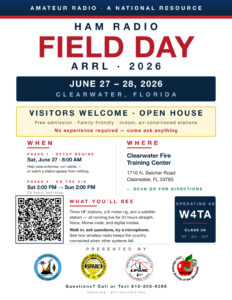
ARRL Field Day is a combined event to test our ability to setup radio communication under less than ideal conditions–think temporary antennas, generators and radio gear. Our event this year is a combined event with four clubs—the Clearwater Amateur Radio Society (CARS), St. Petersburg Amateur Radio Club (SPARC), the Upper Pinellas Amateur Radio Club (UPARC) and the Glorious Society of the Wormhole (Worms). The date is Saturday, June 27th starting at 2:00 PM EDT until Sunday, June 28th at 2:00 PM EDT. Setup generally begins in earnest at 8:00 AM on Saturday morning. The location for all of this is the Clearwater Fire Department Fire Training Center at 1716 N. Belcher Road in Clearwater. Click here for a map.
The operation is comprised of 3 HF stations (two Elecraft K3 radios and one Elecraft K4D). We also have a 6 meter station and a satellite station. We use TR4W for logging and WSJT-X for FT8 operations. All operations are inside in the training center building (air conditioning since it is Florida in June). For modes, we run SSB (voice), FT8 and CW. For CW operators, a Bencher paddle is provided but if you have a favorite paddle or straight key, bring it along. The computer sends CW as well. No experience is necessary beyond a willingness to learn and try something new. If you have never operated a radio, we have plenty of people to show you how to make your first contact. In no time, you will be working stations all over the US and Canada. If you plan on operating, please bring your own headphones. For sanitary reasons, we do not share headphones or microphone headsets. We have adapters for your headphones as well as Heil and RadioSport cables. We also have desk mics for the radios for those that do not have microphone headsets.
We have the equipment all arranged as well as food and drink. Lunch is provided. The main dish (meat) for Saturday dinner is provided by the clubs, with the side dishes and desserts provided by attendees bringing a dish to share (more details to follow). We do ask a few things related to food:
One, we need to know you are coming so please sign up by clicking here so we have an accurate count of the people attending so we do not run out of food.
We also ask that if you are coming for dinner on Saturday, bring a dish (side or dessert) to share with everyone (no, a bag of chips is not a side-dish).
If you do sign-up for meals but your plans change, please let us know so we have as accurate a count as possible.
The public is welcome as one of the purposes of Field Day is to introduce amateur radio to new people.
Field Day is the premier event on our club calendars and we hope to see as many club members and guests as possible. Remember, Saturday June 27th–rain or shine–at 2:00 PM EDT with setup starting at 8:00 AM.
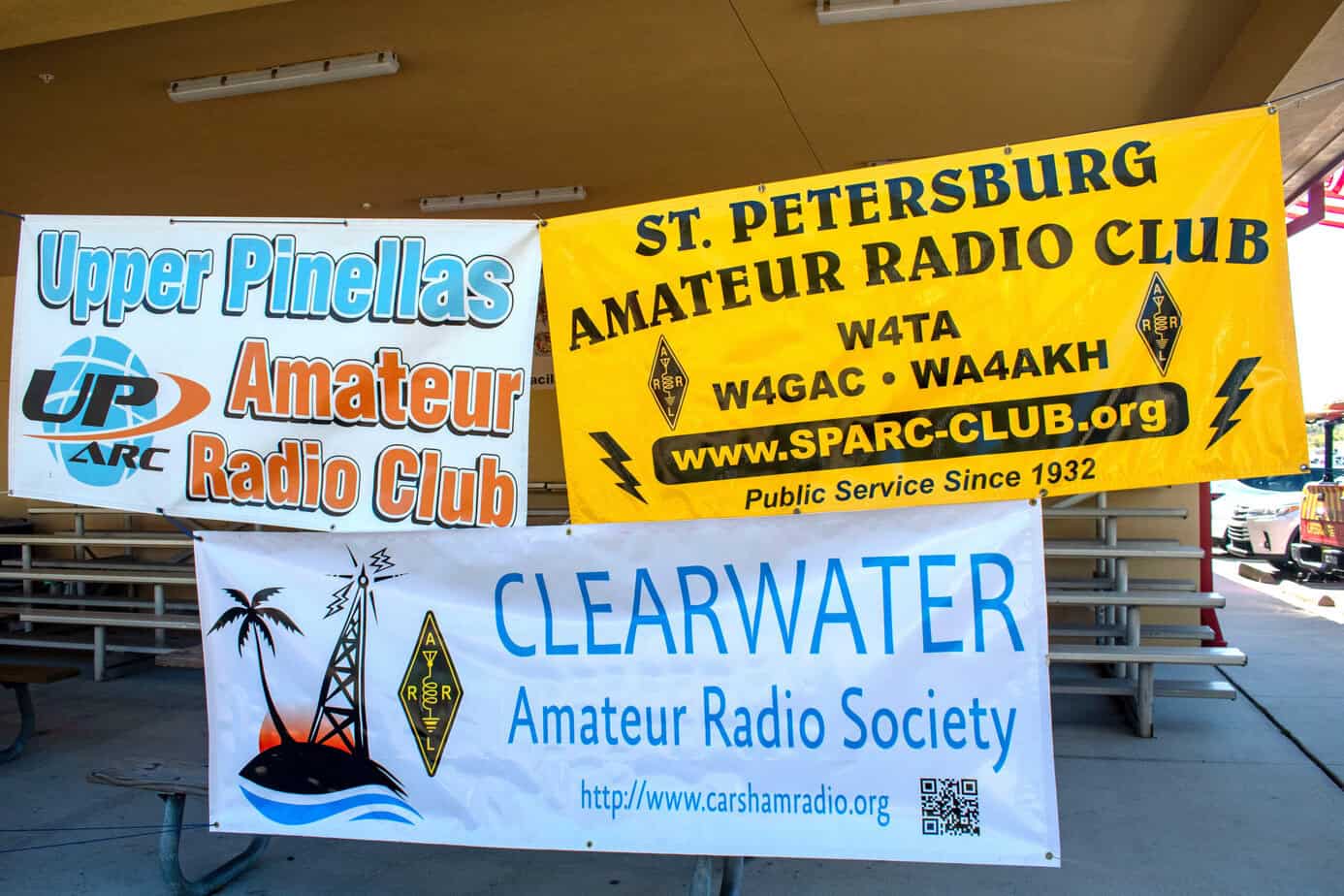
Participating Clubs’ Banners [Photo by K2BHS]On January 24th & 25th, 2026, local ham radio clubs participated in the annual Winter Field Day event in Clearwater, Florida. The day started out as planned with people gathering at 8:00 AM–some even earlier–at the Clearwater Fire Training Center for Winter Field Day 2026. This was a joint effort between the Clearwater Amateur Radio Society, the St. Petersburg Amateur Radio Club and the Upper Pinellas Amateur Radio Club.
The January weather cooperated thus allowing us to operate outside, While the rest of the country suffered in brutal storms, it was quite pleasant here and shirt-sleeve temperatures all around.
[imagely id=”71″]
We had all three stations capable of operating SSB along one CW and one s Digital (PSK31). Being Field Day, we always have a great spread of food to keep everyone fed. Ron and Ruth Appel and their team do a great job of organizing the food portion of Field Day.
HF Operating
Summary
We managed to work a total of 1544 contacts (better than last year) contacts on 5 different bands We contacted stations in all the US sections/states except Alaska as well as all but a few Canadian sections.
A close-up of the HexBeam
Satellite Station
All self-contained in a gator case, the Icom 9700 and other gear for the satellite stationThe Arrow antenna on a Yaesu Azimuth/Elevation rotator for tracking the satellites.
Using Ryan AF4O’s very portable satellite station, Tom NY4I managed to make 6 satellite contacts using RS-44 for SSB contacts and the International Space Station repeater for FM contacts.
Education
Fred W2SUB introducing Field Day to guests
One of our important goals is to always introduce new people to ham radio. With either encouraging a new ham to pick up the microphone and make contacts, offer a few pointers on how to operate the most efficiently or introduce ham radio to someone for the very first time, education and training is why we do all of this (well the food is great too!). Fred W2SUB conducted his usual training sessions. While we do not get points for it like in Summer ARRL Field Day, points are not the motivator anyway.
Winter Field Day Objectives
Winter Field Day switched to an objective-based multiplier system. Possible objectives were as follows:
Operate 100% on alternative power
Operate away from home
Deploy multiple antenna
Make an FM satellite contact
Make a SSB or CW Satellite Contact
Send and receive at least one Winlink email
Copy the Winter Field Day Special Bulletin
Operate on at least six different bands
Use multiple modes
Operate the event QRP
Operate six continuous hours during the event
Of the above objectives, we achieved them all except operating 100% on alternative power and operate the event QRP. Jason N4BOZ sent and received a WinLink message on 2m from the site, Tom NY4I made a satellite contact on FM and SSB and we operated multiple modes with SSB, CW and PSK31.
Oh the Food…
No one goes hungry at Field Day. Ron W4RFA and Ruth Appel lead a great team to help with the food. The clubs provided meals for Breakfast on Saturday and Sunday, lunch on Saturday (cooked by Dean N0OAC and Sarah N0UKS) and Sunday and Dinner on Saturday (along with the potluck). We appreciate all the hepers on the kitchen team.
The annual SPARC after-holiday party is coming up on Sunday February 22, 2026 at 2:00 PM at Kristina’s Cafe in St. Peterburg. Kristina’s Cafe is located at 3590 34th St N (US 19) in St. Petersburg. You will be ordering off the menu and paying for your own meal.
This is a tradition as the holidays are all very busy so this puts it later in the new year. Please email ny4i@ny4i.com to indicate you are coming so we have a head count. All members and spouses are invited to attend.