Press "Enter" to skip to content

SPARC

SPARC Scores in the 2020 RTTY Roundup

The SPARC contest Group, W4TA, placed in the top ten in the 2020 running of the ARRL RTTY Roundup. Participating in the Multioperator, Single Transmitter, High Power category were SPARC members: AA0O Pat, KA1IJA Norm, KA4IOX Paul, KB8ESY Rex, KC1YL Lisa, KI4UIP John, KP2N Ron, KR4U Dave, N2ESP Bob, NY4I Tom, VE3XD Don and W4CU Tom. The final score was 113,730 points, good for tenth place.

Rich, AA2MF, entered the contest in the Single Operator, Low Power category, placing second with a final score of 144,228 points.

Congratulations to all SPARC members that participated in this event.

Related Images:

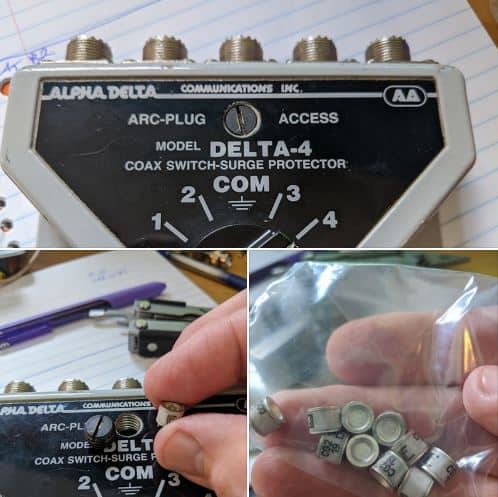
Spare Arc-Plugs for Alpha Delta Switches

Many of us use Alpha Delta coax switches in our stations for antenna selection. These switches use Arc-Plug gas discharge tubes as lightening protection. Spare Arc-Plug elements sell for $10 – $12 from the traditional ham retailers. Mouser Electronics  sells them for $2.37 each in quantities of 10. P/N 576-CG21000.

Thanks to Richard K2UPS for this tip.

Related Images:

January test sessions full

In order to ensure proper social distancing, the SPARC test sessions are limited to 5 people. The Tuesday session in January is already full.

If you want to take an Amateur Radio exam, please check out our VE testing page for contact information to reserve your spot for a future session.

Related Images:

Bell Labs Proves Existence of Dark Suckers

Alan, KO4CR, rebroadcasts an edited version of the Amateur Radio News Line on the SPARC repeater once a week after the evening net. The latest broadcast caused considerable discussion on the morning roundtable as well as the evening pre-net. For those who missed the broadcast, a copy of the article about “dark suckers” follows.

For years it has been believed that electric bulbs emitted light. However, recent information from Bell Labs has proven otherwise. Electric bulbs don’t emit light; they suck dark. Thus they now call these bulbs dark suckers.  The dark sucker theory, according to a spokesman from the Labs, proves the existence of dark, that dark has mass heavier than that of light, and that dark is faster than light.

The basis of the dark sucker theory is that electric bulbs suck dark. Take for example the dark suckers in the room where you are. There is less dark right next to them than there is elsewhere. The larger the dark sucker, the greater its capacity to suck dark. Dark suckers in a parking lot have a much greater capacity than the ones in this room.

As with all things, dark suckers don’t last forever. Once they are full of dark, they can no longer suck. This is proven by the black spot on a full dark sucker. A new candle has a white wick. You will notice that after the first use, the wick turns black, representing all the dark which has been sucked into it. If you hold a pencil next to the wick of an operating candle, the tip will turn black because it got in the path of the dark flowing into the candle. Unfortunately, these primitive dark suckers have a very limited range.

There are also portable dark suckers. The bulbs in these can’t handle all of the dark by themselves, and must be aided by a dark storage unit. When the dark storage unit is full, it must be either emptied or replaced before the portable dark sucker can operate again.

Dark has mass. When dark goes into a dark sucker, friction from this mass generates heat. Thus it is not wise to touch an operating dark sucker.

Candles present a special problem, as the dark must travel in the solid wick instead of through glass. This generates a great amount of heat. Thus it can be very dangerous to touch an operating candle.

Dark is also heavier than light. If you swim deeper and deeper, you notice it gets darker and darker. When you reach a depth of approximately fifty feet, you are in total darkness. This is because the heavier dark sinks to the bottom of the lake and the lighter light floats to the top.

The immense power of dark can be utilized to a man’s advantage. We can collect the dark that has settled to the bottom of lakes and push it through turbines, which generates electricity and helps push it to the ocean where it may be safely stored. Prior to turbines, it was much more difficult to get dark from rivers and lakes to the ocean. The Indians recognized this problem and tried to solve it. When on a river in a canoe traveling in the same direction as the flow of dark, they paddled slowly, so as not to stop the flow of dark, but when they traveled against the flow of dark, they paddled quickly so as to help push the dark along its way.

Finally, we must prove that dark is faster than light. If you stand in an illuminated room in front of a closed, dark closet, then slowly open the door, you would see the light slowly enter the closet, but since the dark is so fast, you would not be able to see the dark leave the closet.

In conclusion, Bell Labs stated that dark suckers make all our lives much easier. So the next time you look at an electric light bulb, remember that it is indeed a dark sucker.


Related Images:

Copy the Field Day Bulletin…

A normal task we always do on Field Day is to copy the W1AW special bulletin sent each year before and during Field Day. This activity simulates what you would do if in a real emergency and you were relying upon bulletins from the ARRL for information. So it is a good skill to learn. To boot, you get 100 bonus points for doing it.

The bulletin is sent in multiple modes (CW, digital (RTTY, PSK31 and MFSK16) and phone. This starts at Friday night at 8:00 local time with CW, then digital at 9:00 and phone at 9:45.

CW frequencies are 1.8025, 3.5815, 7.0475, 14.0475, 18.0975, 21.0675, 28.0675, 50.350 and 147.555 MHz.

Digital frequencies are 3597.5, 7.095, 14.095, 18.1025, 21.095, 28.095, 50.350 and 147.555 MHz. (Note: W1AW will transmit the Field Day Bulletin using 45.45 baud baudot, PSK31 {BPSK Mode}, and MFSK16 in this mode order).

Phone frequencies are 1.855, 3.990, 7.290, 14.290, 18.160, 21.390, 28.590, 50.350 and 147.555 MHz.

Check out this PDF for more information: http://www.arrl.org/files/file/Field-Day/2020/4_37-2020%20W1AW%20Sked.pdf


Related Images:

Field Day 2020 – What’s in a Name?

As you may know, our normal Field Day at the fire training center is not happening this year. Many members are taking advantage of the rule changes to operate class 1D or 1E from home. One of the changes the ARRL made—for this year only—is the ability to aggregate our individual scores under one club name. Please note that you still just make contacts with your own call but when it comes time to send in your Field Day entry, in the spot for club name you can add a name and everyone that uses that same club name will see a single entry in the results for that club name. Your regular entry listing with your own callsign still appears.

This just gives a way for club members to all contribute to a single score—Field Day is not a real contest so it is not terribly important but in case you do, I wanted to send out some recommended names. The reason is that when all the scores are added up, it goes by the match of the club name. Hence, if I sent in my log with a club name of SPARC, a second member uses St. Petersburg ARC and yet a third uses St. Petersburg Amateur Radio Club, those are three different names and three different club names would appear and the scores would not be added up.

To help alleviate that, I thought I would offer some club names to standardize upon to minimize this issue:

Since we normally operate Field Day as a joint club effort—and in respect of those efforts—I have opted to use the same club name I send when I submit the entry in a normal year: I use the following name (somewhat abbreviated for it will not fit on the QST listing:

Clearwater ARS / St. Petersburg ARC / Upper Pinellas ARC

If you want to use one of the specific club names, try one of these:

  • Clearwater Amateur Radio Society
  • St. Petersburg Amateur Radio Club
  • Upper Pinellas Amateur Radio Club

I am also planning an after Field Day Saturday morning presentation to walk through the process of sending in your Field Day entry.  More info on that later but it is tentatively scheduled for 10:00 AM EDT on July 11, 2020.

Related Images:

WP2Social Auto Publish Powered By : XYZScripts.com