Press "Enter" to skip to content

Posts published in “Operating”

SPARC Ham Radio Bucket List

The challenge for 2016 is for each SPARC member to expand their activity in our hobby. To this end, the SPARC Bucket List below provides some potential growth areas. There are no prizes, just the personal satisfaction of learning a new skill or reaching a new goal.

  • Give a presentation at a club meeting
  • Upgrade your license
  • Help setup/takedown at field day siteSt Pete Amateur Radio Club Banner
  • Enter your first Radiosport contest
  • Win a contest award
  • Elmer a newbie
  • Write a SPARC GAP article
  • Write a SPARC Web site article
  • Confirm a new DXCC country
  • Learn Morse Code
  • Teach a radio class
  • Join ARES/ACS
  • Become a VE
  • Work a new mode
  • Bring in a new SPARC member
  • Explain/Demonstrate ham radio to a non-ham.
  • Help setup/takedown at SPARCFEST
  • Build an electronic kit.
  • Attend a hamfest
  • Be a SPARC net control.
  • Send an ARRL Radiogram.

Related Images:

A New R7 Vertical, Two Working FSK stations and One Step Closer on the K3 Remote Station…

Today (12/29/2015), several SPARC members met at the SPARC Clubhouse to work on several Here's what's happeningprojects to help with contesting and other activities at the W4GAC station. Bob N2ESP, John KI4UIP, Dave KR4U, Ron KP2N and Tom NY4I worked on various projects that needed to be done for this weekend’s ARRL RTTY contest. While John, Dave and Bob wrestled the Cushcraft R7 antenna into position outside and ran coax, the rest of us worked on tweaking the Elecraft K3 to work on RTTY FSK mode. For a reason that would become apparent, we could not properly decode signals that we knew were there. As it turns out, we had two issues: one on receive (RX) and one on transmit (TX). The RX issue was that the RTTY frequency was set different on the rig than on the MMTTY program. Once we figured this out, all went well with the receive part. But, then other stations were not decoding us properly. This was a simple issue of switching the FSK polarity to invert our mark and space. Now, it works! There is nothing like reading the manual :). The K3 station will use the Log periodic on 20 and the dipole on 80 along with the Alpha 9500 for 1000 watts. The R7 will be run on other bands as a multiplier station.

Tom NY4I hung around (rather than sit in traffic to Palm Harbor) to work on the K3 remote station. There are a few items that required finishing for the remote station. You may recall, our plan is to allow members to operate the K3 remotely thereby using the radio and antennas at W4GAC from home (great for those of us with limited antennas). After a few configuration issues and hooking up a speaker cable to the back of the K3, Tom was able to connect to the K3 with his K3/0 setup. At least it worked across the room! Not wanting to make any more changed with the contest upcoming, there is a small punch list of items to do to complete this project. This list included routing a few LAN cables, adding an external speaker to the K3 (through the Behringer mixer) and finalizing the inbound WAN ports for access. Please note the technical details were added intentionally to see if anyone has an interest in learning the nitty-gitty details of how remote stations work. If you like mixing hardware and software, it is quite a bit of fun to configure. be sure to ask Tom to help out on this project. There are always things to do and things to learn.

If you want to know how you can use the remote (even with using just your PC or Android device), please talk to Tom. Once the station is fully operational, we will do a training session for those interested.

Related Images:

SKYWARN Basic Spotter Training Available

WHO: Open to all, but you must be 18 to receive an I.D.

Skywarn Logo

WHAT: SKYWARN Basic Spotter training by the National Weather Service.

For more information on SKYWARN, click here.

WHEN: Tuesday, December 15 at 7:00 PM

 WHERE: Pinellas Coty EOC   10750 Ulmerton Rd. Largo, FL 33778

Seating is limited to 100 people so sign up by clicking here.

For additional information, contact:

Clayton Parrott, KJ4RUS

Emergency Management Coordinator

Pinellas County Emergency Management

(727) 464-4526

cparrott@pinellascounty.org

Related Images:

SPARC at the St. Petersburg Science Festival

<h5>by Bob Wanek, N2ESP —

Not a bad place to spend a Saturday...
Not a bad place to spend a Saturday…

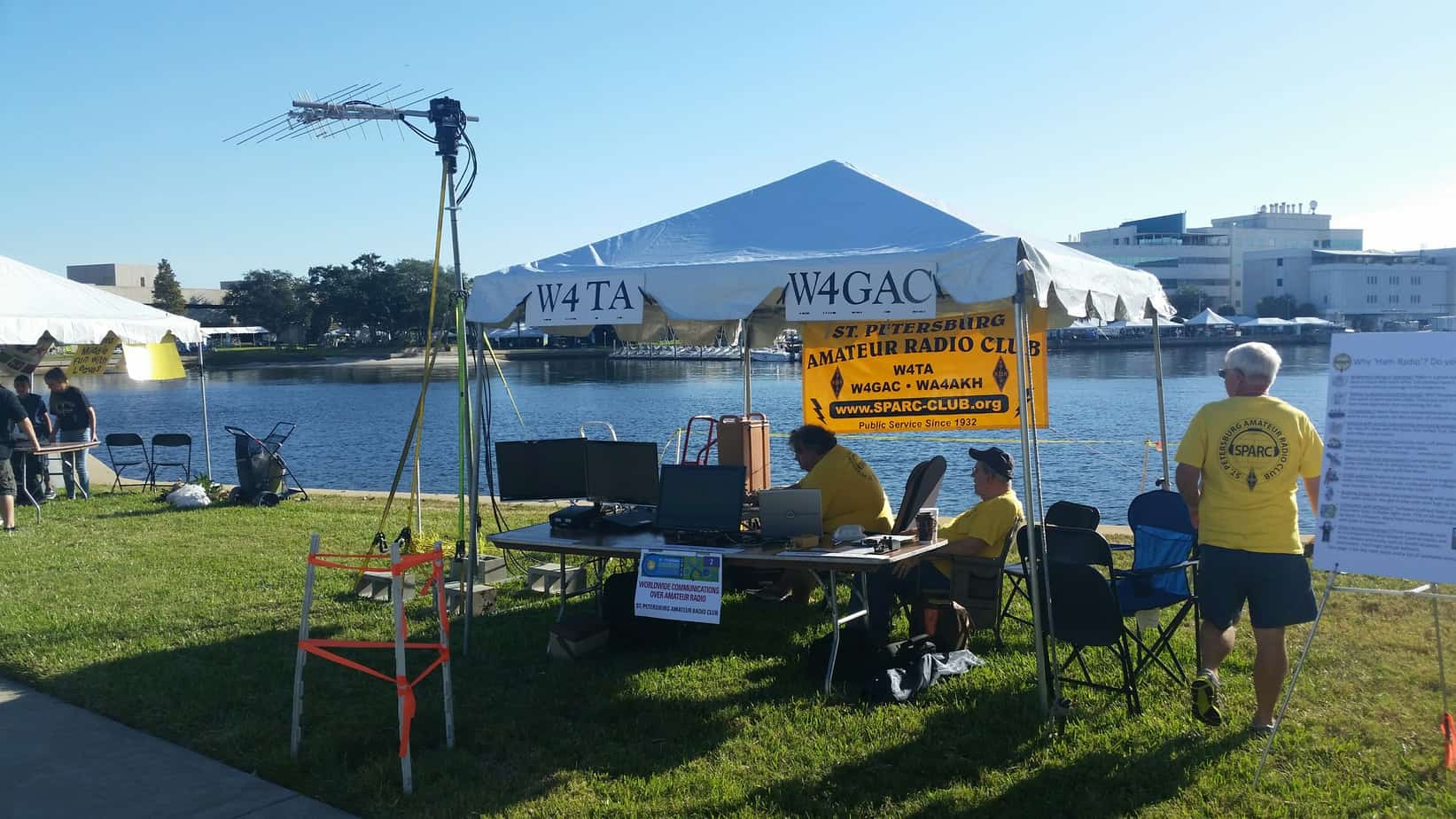
The weather was perfect with a cooling breeze blowing over our waterfront venue. The 20M vertical and VHF/UHF Yagi antennas rose above the tent that provided us shade from the Florida sun. Signage identified our mission as strange sounds emanated from the radios we had set up. This was the scene at the SPARC booth as the 2015 St. Petersburg Science Festival got underway.
Tom, NY4I was searching for satellites to work aided by the custom antenna base/mast assembly designed and built by John, KI4UIP. Two large computer screens showed our visitors the available satellites and radio/antenna operations. Dave, KR4U demonstrated how hams could “text” over the radio using PSK31 as he made contacts around the country. Dee, N4GD and Bob, N2ESP had the best job, teaching our young visitors to tap out their names in Morse code on our code practice oscillators.
Thanks to Leslie, WA4EEZ and Roger, K4SHI who loaned us their PSK/SSB station and Felax, KI4TWQ assisted us getting our station ready for the big show, and Clayton, KJ4RUS who provided our graphics. SPARC members dropping by the booth included Kyle, N4NSS and Coy, KK4JMP.

Related Images:

Attracting New Hams with Bright, Shiny Objects

As you may have read on this site, SPARC is setting up a display at the St. Pete Science Festival. This is the first year I have been in town to attend so I thought it would be a “cool” display to go “whole-hog” with the satellite demonstrations. One of the things that first drew me to amateur satellites was, believe it or not, the rotor turning automatically. I visited a ham in Salt Lake City and he had two beams (2m and 440) on a common boom and they were not only moving in the horizontal plane, but also vertical. Being a software person but also a ham, I always loved whenever software controlled hardware. I always thought it was a great integration of computers and radios to automatically track the antenna. Some of you know at Field Days past, we have used my single 2m/440 beam with a simple azimuth rotor to track the satellites. Well, this year at the science festival, we are going a bit bolder.

The setup will be a Yaesu G5500 Azimuth/elevation rotor so the antennas will move in both planes. I have also separated the antennas so we will have one circularly-polarized (CP) 2m beam and one CP 440 beam. This should make for a very cool display with the antenna tracking things throughout the day. I will make sure there is always a satellite we are tracking. When we do have a pass, we will be making attempts to contact other hams on a satellite.

If you are interested in satellites, I highly recommend you come out and help. This should be a great experience to introduce others to the joy we all have received through amateur radio. I owe what some would call a very successful career to my early interest in amateur radio. If you have young teenagers or grandchildren of the same age, you cannot go wrong introducing them to the technical side of our hobby.

I should also mention that AMSAT had a successful launch today of their Fox1A satellite. If all goes well with the initial checkout, there will be an FM satellite available again. I have made many contacts on the old AO-51 and AO-27 from my dual-band radio while mobile. You really do not need much to work them particularly on the higher elevation passes (like right over your head). More information on working these “easysats” is available here.

Related Images:

WP2Social Auto Publish Powered By : XYZScripts.com