Press "Enter" to skip to content

Posts published in “Lagniappe”

Clubs can support the ARRL’s HOA Bill as Well…

As you may be aware, the ARRL is supporting a grass roots effort to help pass the Amateur Radio Emergency Preparedness Act (“HOA Bill”). Any licensed amateur or GMRS operator can fill out the form available. Hams can use this link: https://send-a-letter.org/hoa/

GMRS operators can use this link: https://send-a-letter.org/gmrs/

If you are both a ham and a GMRS operator, fill them both out…

But clubs can also pitch in to help pass this bill. The difference is clubs were asked to send PDFs of a signed letter (drafted by the organizers of this campaign). The following are the letters that SPARC sent as requested to the organizers and then will in turn hand-deliver the letters to the appropriate representatives. Note that since St. Petersburg is represented by two representatives, I sent a letter for each. These are just for reference. Other local clubs are welcome to the MS Word files if they want to send their own letters. More details about that process if here.

Please support this effort. Even if you do not live in an HOA-community, you never know what the future holds. Many people become hams long after they move into a community (due to availability, choice of schools, proximity to work, etc). Installing an antenna may have not even been a factor when they bought their house; but now as a new ham, it is. Same goes for some future assisted living facility you may have to enter. We all get older and being able to install a reasonable antenna can let you still use your radio into the future. Plus you no doubt have friends that live in an HOA so why not help them out…

https://send-a-letter.org/hoa/

https://send-a-letter.org/gmrs/

Senator Scott – St. Petersburg Amateur Radio Club — Florida

Senator Moody – St. Petersburg Amateur Radio Club — Florida

Representative Castor – St. Petersburg Amateur Radio Club – Florida

Representative Luna – St. Petersburg Amateur Radio Club – Florida

Related Images:

Lagnaippe* Unique Tools – Who Knew

In preparing to do some rewiring in my shack, I investigated the use of crimp-on coax connectors. I ended up purchasing a crimp tool along with coax connector and Powerpole dies from DX Engineering. I can now easily install crimp-on connectors on a variety of coax cables. The die for Anderson Power Pole connectors will make their installation a snap as well.

In my research, I checked out a number of YouTube videos on the subject, I found this one very interesting.

Special Coax Scissors

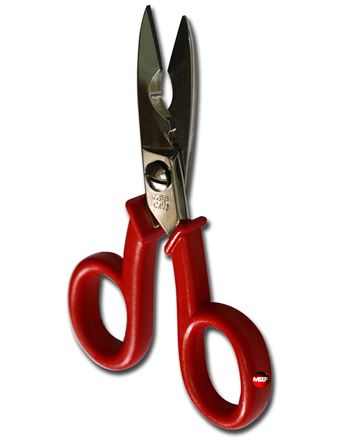
What caught my attention were the scissors used to cut the outer insulation, inner dielectric, foil shield and braid. Digging deeper revealed that they are Messi & Paoloni “Special Coax Scissors.”

These scissors were designed by M & P “to ensure accuracy and delicacy while cutting the cable..”

What makes these scissors unique is the high hardness steel straight nickel-plated blades. The external sides of the blades are coated with a thick chrome plating. The internal mating sides of the blades are not chromed to ensure a correct friction while closing, prolonged life and reducing wear in the blade and its unique cable stripper notch. Its the cable stripper notch that differentiates these scissors from ordinary scissors. Unlike most conventional wire strippers, the edges of the notch are razor sharp. The large size of the notch makes it easy to work with coax up to 3/8” OD. The cut is extremely clean and leaves no burrs. They are also much safer than using a razor blade to make the necessary cuts.

I purchased my scissors from GigaParts. .

Powerpole Insert/extract Tool

I use Anderson Powerpole connectors for all my 12VDC connections. My new crimping tool (see above) will make their installation easier. My research also revealed another tool previously unknown to me, the Anderson Powerpole Insertion/Extraction tool.

This tool is used with the Powerpole 15 to 45 amp terminals. The tool facilitates extraction of the metal terminals from assembled Powerpole connectors and easy insertion of the metal terminal into an empty Powerpole housing.
I purchased my tool from DX Engineering.

*Lagniappe: (LAN-yap) “A little something extra.”

Related Images:

SPARCFest cancelled

Due to the 50 person limitation placed on using Freedom Lake Park due to the COVID-19 pandemic, SPARC has decided to cancel this year’s SPARCFest that was to be held on November 14.

Related Images:

Bell Labs Proves Existence of Dark Suckers

Alan, KO4CR, rebroadcasts an edited version of the Amateur Radio News Line on the SPARC repeater once a week after the evening net. The latest broadcast caused considerable discussion on the morning roundtable as well as the evening pre-net. For those who missed the broadcast, a copy of the article about “dark suckers” follows.

For years it has been believed that electric bulbs emitted light. However, recent information from Bell Labs has proven otherwise. Electric bulbs don’t emit light; they suck dark. Thus they now call these bulbs dark suckers.  The dark sucker theory, according to a spokesman from the Labs, proves the existence of dark, that dark has mass heavier than that of light, and that dark is faster than light.

The basis of the dark sucker theory is that electric bulbs suck dark. Take for example the dark suckers in the room where you are. There is less dark right next to them than there is elsewhere. The larger the dark sucker, the greater its capacity to suck dark. Dark suckers in a parking lot have a much greater capacity than the ones in this room.

As with all things, dark suckers don’t last forever. Once they are full of dark, they can no longer suck. This is proven by the black spot on a full dark sucker. A new candle has a white wick. You will notice that after the first use, the wick turns black, representing all the dark which has been sucked into it. If you hold a pencil next to the wick of an operating candle, the tip will turn black because it got in the path of the dark flowing into the candle. Unfortunately, these primitive dark suckers have a very limited range.

There are also portable dark suckers. The bulbs in these can’t handle all of the dark by themselves, and must be aided by a dark storage unit. When the dark storage unit is full, it must be either emptied or replaced before the portable dark sucker can operate again.

Dark has mass. When dark goes into a dark sucker, friction from this mass generates heat. Thus it is not wise to touch an operating dark sucker.

Candles present a special problem, as the dark must travel in the solid wick instead of through glass. This generates a great amount of heat. Thus it can be very dangerous to touch an operating candle.

Dark is also heavier than light. If you swim deeper and deeper, you notice it gets darker and darker. When you reach a depth of approximately fifty feet, you are in total darkness. This is because the heavier dark sinks to the bottom of the lake and the lighter light floats to the top.

The immense power of dark can be utilized to a man’s advantage. We can collect the dark that has settled to the bottom of lakes and push it through turbines, which generates electricity and helps push it to the ocean where it may be safely stored. Prior to turbines, it was much more difficult to get dark from rivers and lakes to the ocean. The Indians recognized this problem and tried to solve it. When on a river in a canoe traveling in the same direction as the flow of dark, they paddled slowly, so as not to stop the flow of dark, but when they traveled against the flow of dark, they paddled quickly so as to help push the dark along its way.

Finally, we must prove that dark is faster than light. If you stand in an illuminated room in front of a closed, dark closet, then slowly open the door, you would see the light slowly enter the closet, but since the dark is so fast, you would not be able to see the dark leave the closet.

In conclusion, Bell Labs stated that dark suckers make all our lives much easier. So the next time you look at an electric light bulb, remember that it is indeed a dark sucker.


Related Images:

SPARC Lagniappe

  • Web Site of Interest


For an all-inclusive weather site, check out Mike’s Weather Page (https://spaghettimodels.com)

  • 65 Great Things about Ham Radio


A few years ago, CQ Magazine ran an article titled “60 Great Things about Ham Radio.” The series was quite popular and it’s repeated below with the permission of CQ Magazine, including a few updates and five more “Great Things about Ham Radio.”

1. It works when nothing else does
2. It makes you part of a worldwide community
3. The opportunity to help neighbors by providing public service and emergency communications
4. Some of the nicest people you’ll ever meet
5. Some of the smartest people you’ll ever meet
6. Some of the most interesting people you’ll ever meet
7. Some of the most generous people you’ll ever meet (along with some of the cheapest!)
8. Lifelong friendships
9. Friends around the world (including those you haven’t met yet.)
10. The opportunity to go interesting places you might not otherwise go to
11. The opportunity to do interesting things you might not otherwise get to do
12. The opportunity to expand your knowledge of geography
13. The opportunity to expand your knowledge of earth and space science
14. Practical uses for high school math
15. Practical uses for high school physics
16. A good way to practice a foreign language
17. A good way to keep in touch with faraway friends and relatives
18. A good way to get driving directions when visiting someplace
new (with or without GPS.)
19. A good way to find the best places to eat when visiting someplace new (with or without GPS.)
20. Finding “non-touristy” off-the-beaten-path places to stay, eat, visit, etc.
21. A good way to learn about virtually any topic
22. A good way to bridge the generation gap
23. A good way to keep tabs on elderly/infirm people
24. People named Joe (Walsh, Rudi, Taylor.)
25. How many of your non-ham friends have actually talked
to someone in some remote place such as Cape Verde or the Seychelles?
26. How many of your non-ham friends might have talked to an astronaut aboard the space station?
27. How many of your non-ham neighbors might have a satellite uplink station in their basements—or in the palms of their hands?
28. How many of your non-ham neighbors might have a TV studio in their garage?
29. What other hobby group has designed, built, and had launched its own fleet of communication satellites?
30. Where else can you play with meteors?
31. Moon bounce
32. Informal way to improve technical skills
33. Informal way to improve communication skills
34. Introduces a variety of career paths
35. Offers unparalleled opportunities for career networking
36. Opportunities for competition in contesting and foxhunting
37. A good way to collect really cool postcards from around the world (despite the growth of electronic confirmations.)
38. Nearly endless variety of different things to do, on and off the air
39. Ham fests
40. Dayton
41. Field Day
42. Working DX
43. Being DX
44. DXpeditions
45. Contesting
46. Award-chasing
47. Double-hop sporadic-E
48. Worldwide DX on 6 meters (once or twice every 11 years.)
[The current extended sunspot minimum has shown that mechanisms
other than F2 propagation can offer intercontinental DX
on the “magic band” at any point in the solar cycle.]
49. Tropospheric ducting
50. Gray-line propagation
51. TEP, chordal hops, etc.
52. Getting through on CW when nothing else will
53. Unexpected band openings
54. Building your own gear
55. Using gear you’ve built yourself
56. Operating QRP from some remote location
57. Experimenting with antennas
58. Working DX while mobile or while hiking
59. Experimenting with new modes and new technology
60. The opportunity to help build an internet that doesn’t rely on the internet
61. DXing on your HT via IRLP and Echolink
62. Contributing to scientific knowledge about propagation
63. Keeping track of other people’s GPS units via APRS
64. Ham radio balloon launches to the edge of space, and as always…
65. Reading CQ!

  • Ode to a QRPP’r


A poem by Lance Harmon, WA7OKF, published in the The Milliwatt: National Journal of QRPp August 1971


A battery, a box, some components too,

transistors and heatsinks, solder and glue —

these are the tools of a dedicated man,

the radical of low power — the QRP ham.


The iron now cold and parts all aligned,

the “dream” rig is finished in a few hours time,

with minor adjustments and antenna all tuned.

He prepares now to call his first CQ.

With the skill of a veteran of QRO times;

he taps out CQ and then signs.

Patiently he tunes the receiver with care,

listening for the answer that he hopes will be there;

but, alas, he must put “N.C.” in the station logbook.


He gives his mini-beeper another close look,

and, all in order, he tries once again,

then listens, and listens, again in vain.


He changes the quad’s direction this time,

calls again, then he signs;

with ears in the cans and with delicate touch

he tunes the band to hear his call —

and then, down in the mud, in the static and all,

could this really be his very own call?

Indeed it is true!

The answer he now hears —

the station signs GA OM GUD SIG DWN HR.


And so, we’ve gained another for our growing lot

whose power is rated in milliwatts.

So, give it a try,

let those linears cool down —

and discover the fun of powering down.


*Lagniappe: (LAN-yap) “A little something extra.”

Related Images:

WP2Social Auto Publish Powered By : XYZScripts.com