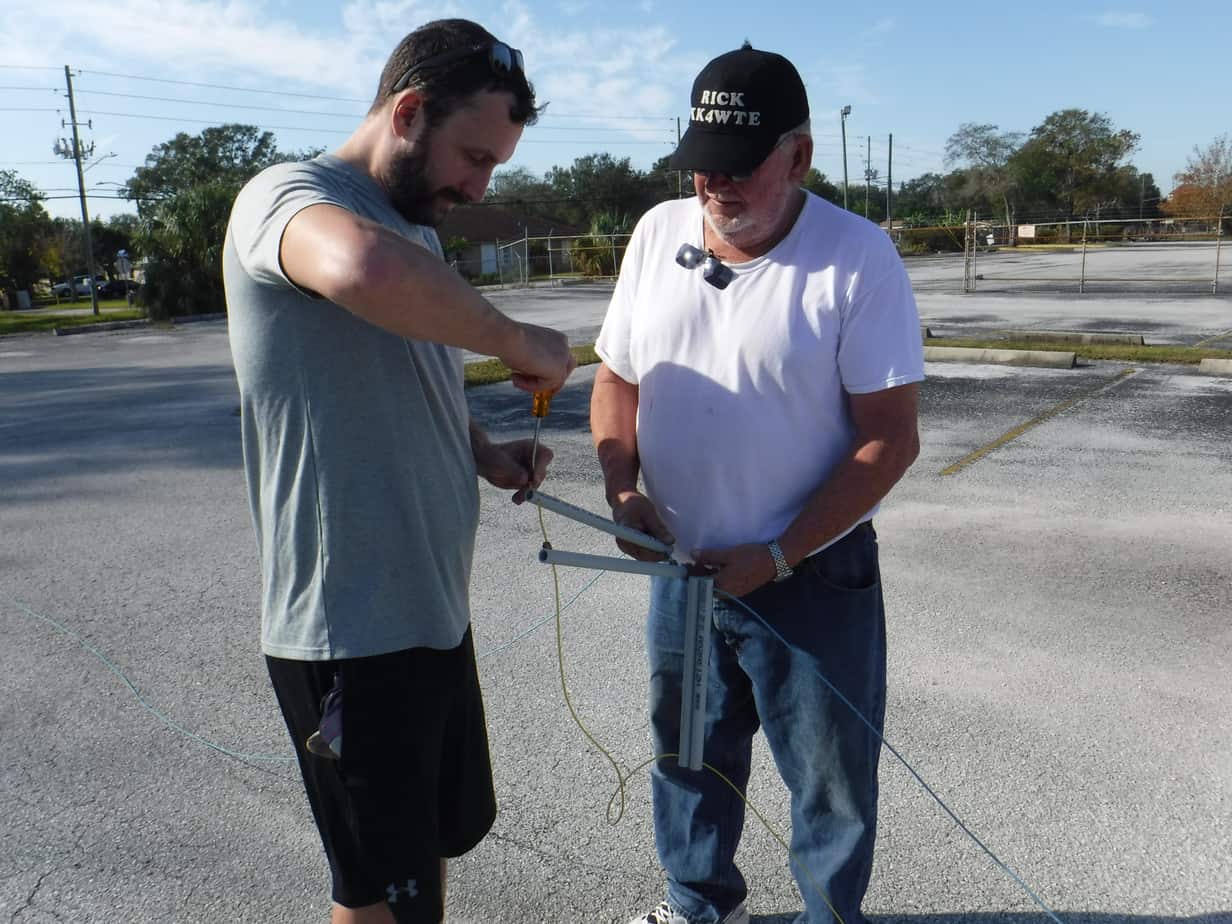
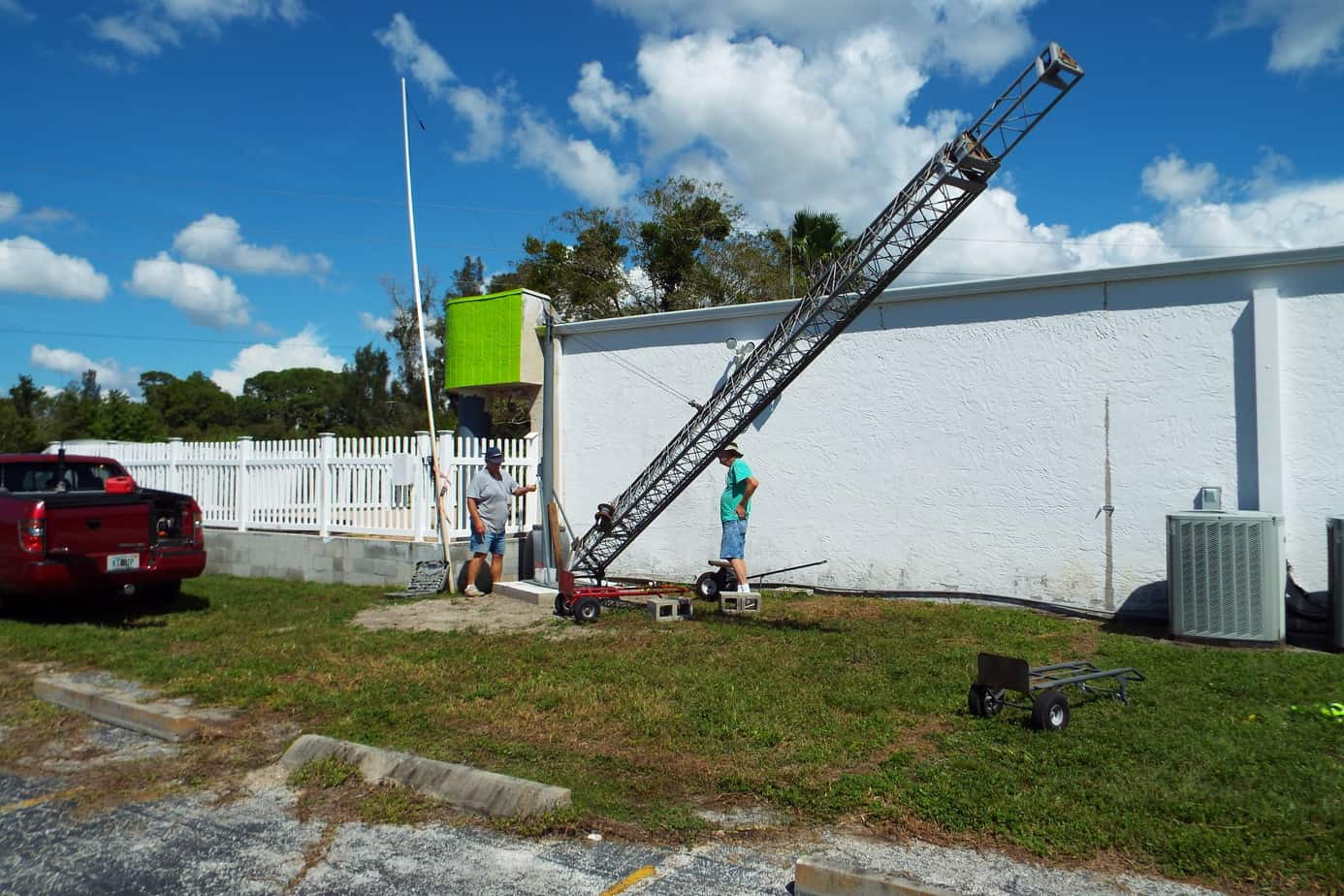
SPARC members are all welcome and encouraged to assist at the assembly, repair and erection of antennas at W4GAC. Starting at 9:00AM on Saturday 12/16, the tower will be lowered to replace the rotator. At the same time, adjustments will be made to accommodate the center support for the new 80/160 dipole. The south end of the dipole will be attached to a tree near 90th Avenue. The north end will terminate at a new “tower” to be installed at the north end of the property. Finally, a new 40M vertical will be installed on the tower atop the shipping containers.
Everyone is welcome. Workers, assemblers, hold diggers, supervisors, laborers, students, etc.
Welcome to the new look of the SPARC website. This is the same WordPress site underneath but a new format. The new site uses a three column design so one does not have to scroll down the page to see current topics. You can also see the 10 most recent posts on the right under the current weather conditions at the SPARC station.
Take it for a spin and let us know what you think… Feel free to comment on Facebook or to webmaster@sparc-club.org
One could not have asked for better weather for the annual SPARCFest this year. The event was held at Freedom Lake Park in Pinellas Park on Saturday November 11, 2017. As usual, even though the official start is 8:00 AM people start congregating around 6:00 AM to setup and some even to grab early bargains—although sales really start at 8.
SPARC members swapping lies…Looking towards the ARRL table…
This event continues to grow in popularity due to the time of year, comfortable weather, lack of rain and free admission to buyers and sellers. This year drew the largest crown yet with many people selling gear including a great selection of HF gear. SPARC offered coffee and doughnuts, cold drinks and sausage biscuits (new this year instead of the SPARC Dogs).
Tom NY4I and Paul KA4IOX deep in debate on grounding techniques.
SPARC had a large numbers of items for sale due to an increase in Silent Key sales for which the club was asked to help. SPARC sells silent key equipment (most on consignment for estates) to both help out the families of those recently departed hams and it also helps fund club activities for the year.
Getting Ready for the Crowd [N2ESPhoto]SPARC completed another successful day at the St. Petersburg Science festival. Situated under a big oak tree on the breezy shore of Tampa Bay, SPARC station W4GAC was again on the air.
This year we focused on CW. We noticed in prior events that the sound of Morse code emanating from our tent caused people to ask “what is this?” We set up a simple 20M CW station and put CW guru Dave KR4U behind the key. In spite of so-so propagation, Dave was able to work numerous European stations, as there was a German contest underway. Domestically, the New York QSO party kept Dave busy with domestic QSOs. Dave’s brass pounding also peaked the interest of festival goers.
Dave KR4U at the CW Station [N2ESPhoto]
Once we got folks attention, a variety of code equipment was available for visitors to try. Most of the kids enjoyed tapping out their name on a basic code practice oscillator using a CW cheat sheet. When they found the tone pitch knob, many of them became musicians, changing the pitch of the signal as they sent some really ugly code. Another crowd favorite was a code key connected to a Morse decoder that Dee N4GD made using a Raspberry Pi computer. Send a letter in code and it popped up on the screen….cool. Finally an electronic keyer with iambic paddle provided a third alternative to keep the CW flowing.
Future CW Op Learns the Code [N2ESPhoto]Our booth was manned by Dave KR4U, Rex, KB8ESY, John KI4UIP, Bob N2ESP, Dee N4GD and Ed NZ1Q. In addition to answering numerous questions, we passed out a number of our SPARC brochures. The most frequently asked question was how far away have you talked? When KR4U replied “I’ve talked with Russia, Belgium, Spain, Germany, France folks eyes opened in amazement. When folks then asked “what was the farthest conversation you have ever had;” the answer was ½ way around the world… any further then you turn your antenna to go the short way. Folks were truly awestruck.
Future CW Ops at Work [N2ESPhoto]
All the SPARC participants agreed this was one of our best years at the festival, and offered suggestions for improvement next year. Dropping by for a visit were club members Kyle N4NSS, Molly KN4GFN and Bob WB4MCF. It’s a lot of fun to watch the kids quickly associate the dits and dahs with the alphabet and subsequently their name. Hopefully we planted the ham radio bug in one or two visitors and will see them on the air in a few years.
If you would like to join in the fun of next year’s Science Festival, contact one of the club officers.
Future CW Contester [N2ESPhoto]Dad lends new Op a hand [N2ESPhoto]
SPARC contesters enjoyed entering W4TA in the newly reestablished Makrothen RTTY contest. Makrothen is a Greek word meaning distance. In spite of poor propagation, the SPARC team made 541 QSOs with a claimed score of 2,203,706 points.
Tom W4CU running while Ron KP2N watches [N2ESPhoto]What makes the Makrothen different from the other contests we compete in is the method of scoring. Most contests are scored based on the number of QSOs times the number of “multipliers” worked in the contest. The points value awarded for each QSO varies with each contest. Different points value may be assigned to stations worked in a country different from yours, operating mode, or band. Multipliers also vary by contest. Typically each DX country is a multiplier; multipliers can also be established geographic radio “zones” worldwide. This type of scoring is biased in favor of population centers, with east coast US stations closer to Europe, with its large number of countries and the Caribbean with numerous small island countries.
Leslie WA4EEZ running as Tom NY4I looks on [N2ESPhoto]As its name implies, the value of a QSO in the Makrothen contest equals the distance (in kilometers) between the two stations. The information exchanged between the two stations includes the Maidenhead grid square in which each station is located. The four character grid square designator exchange gives a rough indication of each station’s latitude and longitude. This information is then used by computer logging program algorithms to determine the distance between the two stations. Hams regularly working DX are aware that it is more difficult to work stations on the lower frequency bands. To encourage the use of these bands in the contest, QSO point values on 40M and 80M are multiplied by 1.5 and 2.0 respectively. In the event both stations are in the same grid square, a value of 100 points is assigned to the QSO.
N1MM+ RTTY contest software [N2ESPhoto]This contest is run in three eight hour segments (8PM-4AM, 12PM-8PM and 4AM-12PM) that are separated by three eight hour off times.
SPARC members participating in this event were: Paul KA4IOX, Rex KB8ESY, Ron KP2N, Dave KR4U, Bob N2ESP, Richard N4BUA, Dee N4GD, Tom NY4I, Tom W4CU and Leslie WA4EEZ.
If you are interested in participating in any of the contests we enter, contact one of the folks above. No experience is necessary, we will provide an Elmer (mentor) to get you started in this competitive area of our hobby.
Besides this being the start of contest season, we also have some other events that you might want to check out.
On October 13 through October 15, there is the Makrothen RTTY contest at the club station. See here for more info….
On October 21, it’s the St. Petersburg Science Festival. Look for more info here and at the club meeting but this is a chance to spend a great day on the waterfront in St. Pete showing amateur radio to kids of all ages.
On October 28 in Palm Harbor, is the Upper Pinellas ARC Hamfest/tailgate. More info on that is here.
We also have the ever-popular Tampa Bay Hamfest on December 8th and 9th. More info on that hamfest is found here.